Fear and desire.
Why a good scare brings you closer (and how to play with it on Halloween night)
Racing heart, short breath, prickling skin: fear looks a lot like desire, and the brain sometimes mixes them up. What science says, and how to play with it as a couple on Halloween night.
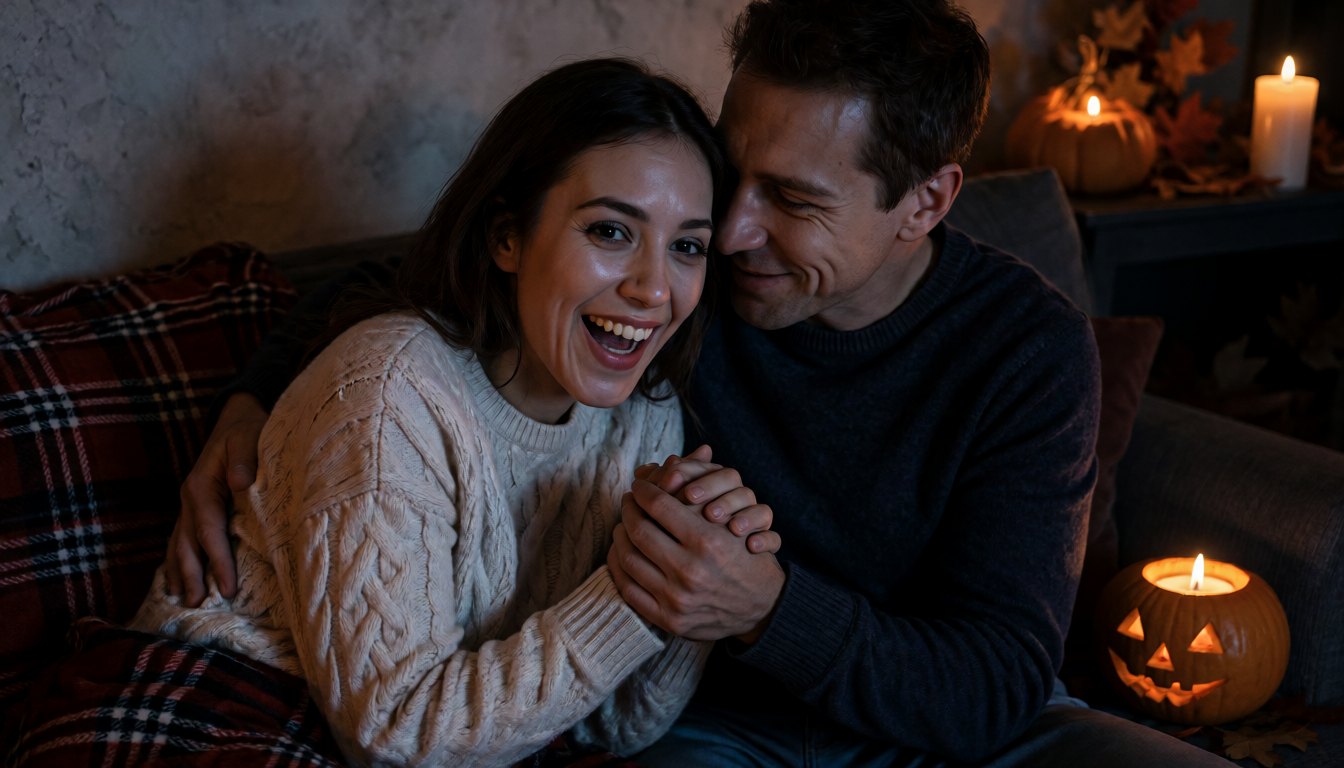
A couple under a blanket watching a horror film, she jumps and laughs, he smiles, in the glow of the screen and a pumpkin. AI-generated illustrations.
See in Photo Comic artIn short.
5 questions, 5 answers. The detail is in the part shown.
Why does fear bring couples closer?
Because it puts the body on alert (fast heart, short breath, sensitive skin), a state very close to desire. When scared, we also instinctively seek the other person's warmth: the touch lands on a body that's already running hot.
Part 01 · Why fear brings people closerWhat did the suspension bridge experiment show?
Men approached by a female researcher on a wobbly bridge over a ravine called her back far more often than those approached on a sturdy bridge. Their hearts were still pounding, and they are thought to have put part of that agitation down to the young woman.
Part 04 · The suspension bridge experimentCan fear make you fall in love?
Not on its own. The stirring amplifies an attraction that already exists, but it can also sharpen a rejection. The effect is short-lived, it fades once you know what's making your heart race, and how strong it is remains debated.
Part 05 · What science doesn't claimWhat horror film should couples watch?
A film that makes you jump without turning your stomach: haunted house, ghost, single-location thriller, or a horror comedy if one of you doesn't much like being scared. Gore is for fans on both sides, and you decide the level together.
Part 06 · Horror films for twoWhat can couples do on Halloween night?
Get scared together, at a dose you choose: a haunted house, a horror escape room, a night walk with a single torch for two. And plan the afterwards (a hot drink, the journey home), because it's when the excitement drops that you draw closer.
Part 08 · Haunted house, escape room, night walk
Why fear brings people closerThe thrill, an old ally of seduction
Why does fear bring people closer? Because it puts the body on alert (racing heart, short breath, prickling skin) and that state looks a lot like desire. And because, when we're scared, we instinctively look for someone's warmth. The two feed each other: we huddle up, and that touch lands on a body that's already running hot.
Halloween night is the perfect playground for this little phenomenon. A house in the dark, a film full of creaks, streets crowded with masks... Nothing dangerous, just enough unease for the other person's hand to become the most important thing in the room.
This isn't just a cinema illusion. Psychologists have studied this link between strong emotions and attraction, and their work explains why we walk out of a horror film glued to the person next to us (sometimes a little more in love than when we walked in). The question is how to play with it as a couple, out and about as well as at home, without forgetting the tenderness that follows the thrill.
What fear does to the bodyHeart, breath and skin on alert
When something scares you, even a papier-mâché monster, your body doesn't wait for your reason to weigh in. In a split second, the nervous system switches to alert mode, the one that got our ancestors ready to run or fight. Adrenaline and the other stress hormones flood the bloodstream.
You feel the effects right away:
- the heart speeds up and pounds, sometimes loud enough to hear in your ears,
- the breath grows shorter, you hold it and then let it out all at once,
- the pupils dilate,
- the skin bristles (goosebumps), hands turn clammy, cheeks flush or go pale,
- the muscles tense, ready to spring.
One last effect, less well known, and it's the one that interests us: vigilance. A body on alert watches everything. The slightest noise, the lightest touch is perceived with unusual sharpness, as if someone had turned up the volume on your senses.
That's why a hand placed on a knee during a tense scene makes you jump, then stays in your memory. At that moment, the skin is all nerve endings. All it wants is to feel.
 1 more illustration for members
The same scenes in Comic art. Members only: a free account is enough, no bank card.
See them
Fear or desireWhy the body mixes them up
Seen from the inside, fear and desire look almost identical. A fast heart, short breaths, wide pupils, warm cheeks, sensitive skin: give or take, that's the checklist of a first date that's going well (several of the signs of attraction you watch for in the other person are on it).
The body, in short, has a rather limited vocabulary. It knows how to say "something important is happening", much less how to say what. To name what we're feeling, the brain looks around: the setting, the people there. The body sounds the alarm, the brain picks the name of the emotion.
Most of the time, it gets it right: a dog barking behind a fence means fear. But when the situation is blurry (half-light, eerie music, an attractive person very close by), the label can slip. Part of the stirring is then credited to the person next to you.
The body sounds the alarm, the brain picks the name of the emotion.
Part 3 · Fear or desire
The suspension bridge experimentWhen the brain gets the cause wrong
What does the suspension bridge experiment show? That men shaken up by a dizzying crossing find the woman who approaches them at that moment more attractive. This experiment, the most famous of its kind, took place out in the wild.
Psychologists picked two bridges. The first, a suspension bridge of planks and cables strung across a ravine, swayed at the slightest step, with low handrails and rocks far below. The second, a little further on, was a sturdy wooden bridge, low over a stream.
On each one, a young woman approached the men crossing without a female companion. She introduced herself as a researcher, had them fill in a short questionnaire and make up a little story from a picture. To finish, she jotted down her first name and number on the corner of a sheet, in case they wanted to know more.
The men on the swaying bridge were far more likely to call her afterwards, and their stories contained more sensual hints. On the quiet bridge, nothing of the sort. And when a man ran the survey, the difference vanished.
The accepted explanation: hearts pounding and legs still wobbly, these men put part of their agitation down to the young woman smiling at them. Ever since, this has been called misattribution of arousal. The vertigo was real, and the attraction inherited it.
What science doesn't claimThe nuances to keep in mind
Can fear make you fall in love? No, and it's better to say so before turning every date into a bungee jump. The suspension bridge isn't a love potion, and the research that followed has mostly added shades to the picture.
First, the stirring amplifies, it doesn't create. If the person next to you already appeals to you a little, the fever of the moment can strengthen the attraction. If they leave you cold, or get on your nerves, the same fever can sharpen the rejection. The thrill pushes you the way you were already leaning.
Next, the effect is fragile. It works mostly when your mind is no longer on what's making your heart race: if you're still thinking about the monster, the brain is less easily fooled. The confusion lasts a few minutes, not a season, and results vary from one study to the next. The mechanism exists, how strong it is remains debated.
What holds up better is a broader finding: couples who share new and slightly exciting experiences feel closer. No need for a drop beneath your feet, an evening out of the ordinary is enough (it's one of the levers for reviving desire in a long-term couple).
Horror films for twoHow to pick the right one
What horror film should you watch as a couple? One that makes you jump without turning your stomach. Spending two hours with your hands over your eyes brings no one closer: what you want is rising tension you can share.
A few pointers:
- atmospheric films (haunted house, ghost, curse) build fear slowly, with regular jump scares: the sofa's best friends,
- single-location films and thrillers play on anticipation, for those who prefer suspense to monsters,
- horror comedies mix laughs and chills, perfect if one of you doesn't much like being scared,
- gore is best left to declared fans, on both sides, because disgust pushes you apart more than it pulls you together.
You decide the level together, and that's already a little seduction game. Ask the other person what really scares them, the film that kept them awake as a kid, the one they've never managed to finish. You'll learn things, and you'll know what to avoid.
Also rule out any film whose subject reminds one of you of a painful experience (a bereavement, an assault, being trapped). And if you're torn between two titles, pick the less frightening one: you can always watch a second.
Sofa, blanket and lightingThe setup that makes you snuggle up
What brings you closer is less the screen than the way you settle in front of it.
- One sofa, one blanket. Two blankets are two territories. With just one, your legs are bound to find each other.
- Low light, not total darkness. A lamp behind the sofa or a candle in a pumpkin: enough to see each other's face, little enough for the screen to set the mood.
- The sound a little loud. That's what makes you jump, far more than the picture.
- Phones put away. A screen lighting up in someone's hand breaks the tension in a second.
- Snacks within reach, or better still, a Halloween dinner for two as a prologue.
During the film, let your bodies take over. An arm resting on the back of the sofa, an offered shoulder, an open hand on the cushion between you: so many discreet invitations. Whoever gets scared can simply slip in, no need to ask.
And don't be afraid of the pauses. Whispering about a scene, laughing at a jump, mocking a character who heads down to the cellar without a torch... These little breaks count as much as the film: that's when you look at each other.
Haunted house, escape room, night walkGetting scared together outdoors
What can couples do on Halloween night when they feel like going out? Get scared together, but on your feet. You move through the dark, hide behind each other, laugh nervously: the suspension bridge, leisure edition.
The haunted house. Theme parks and pop-up venues put on haunted walk-throughs around 31 October, with actors in full makeup. Go as a pair rather than in a group, and decide before you go in who walks in front (the order often changes along the way, that's the best part).
The horror escape room. One hour to get out of a puzzle room with a creepy setting. The fear is gentler there, but you have to cooperate and trust each other. You come out feeling a little like partners in crime.
The night walk. Simpler, and free: a forest path at nightfall or a deserted old town, with a single torch for two (that detail matters). The noises, the shadows and the cold do the rest.
Whatever you choose, plan the afterwards (a hot drink, the journey home): the excitement drops fast, so it may as well drop into each other's arms. And if you want to go out in costume, here's how to dress up as a couple for Halloween.
Dark room and blindfoldThrill games at home
Don't feel like going out? Home is enough. A few simple games recreate the same mix of suspense and skin on alert, and you set the intensity yourselves.
The dark room. Turn everything off in a room you know well, cleared of anything you could trip over. One of you hides, the other comes in and gropes around, without a word. Find them and you've earned a kiss, then you swap roles. The dark makes your heart race, the silence makes you strain your ears.
The blindfold. One of you sits down, eyes blindfolded (a folded scarf will do). The other circles slowly, without announcing what's coming: a breath on the nape of the neck, a feather on the forearm, a silky fabric on the cheek, a hand on the shoulder. Deprived of sight, the body is on the lookout, and every touch arrives with startling intensity.
Three rules apply to all these games: you talk about it beforehand, you choose a word to stop everything (a simple "lights" does the trick), and the blindfolded person can take off the blindfold whenever they like. It's because you feel safe that you can savour the thrill.
Whispers, hot and cold, a story in your earSkin wide awake
Shivers don't only come from fear. A voice, a change in temperature is sometimes enough to give you goosebumps.
The whisper. Lean in to the other person's ear until you're almost brushing it and speak very softly. The warm breath sliding down towards the neck makes most people shiver, and slowness matters more than words.
Hot and cold. An ice cube in a glass, a cup of hot tea beside it. Run the ice cube for a few seconds along the inside of the wrist or the hollow of the neck, then lay your fingers, warmed by the cup, on the same spot. The contrast surprises, and the person on the receiving end waits for what comes next, holding their breath.
The story in your ear. Lights out, one candle, the other curled up against you, eyes closed. In a low voice, tell a ghost story: an isolated house, a storm, a door creaking upstairs. Describe the sounds, the smell, the cold. At the most unsettling moment, pause, and lay your hand on theirs.
And nothing stops you from letting the story take a turn: maybe the ghost wasn't so menacing after all... Your listener will soon see where you're going with this.
When fear doesn't helpKnowing when to stop
Not everyone likes being scared, and it's not a lack of humour. For some people, fear never turns into pleasure.
That's true of anxious people, whose body on alert can tip into panic. Of phobias (the dark, enclosed spaces, blood), which are not up for negotiation. And above all of bad memories: an assault, an accident, a bereavement, a childhood where fear was no game. A jump scare or total darkness then wakes up something very different from a thrill.
Lasting stress also kills the mood: an anxious body shuts down, and libido is the first to pay the price. A thrill helps when it's brief and joyful, not when it settles in.
Certain signs should stop everything: tears, breathing that races and won't come back down, a frozen body, an "I'm fine, I'm fine" repeated too fast. Turn the lights back on, stop the film, stay there, without comment.
And one rule with no exceptions: never surprise someone who hasn't said yes. Hiding behind a door, switching the lights off suddenly, grabbing an ankle from under the bed: what amuses two people who agreed to it terrifies the one who didn't see it coming.
After the thrill, tendernessThe moment that matters most
After a good scare, the body comes back down. The heart slows, the muscles loosen, you tremble a little, you laugh for no reason. This decompression is often more intimate than the fear itself: it's where closeness settles in.
Don't spoil it by flicking on the ceiling light. Keep the lighting soft, serve something hot, stay close against each other. Talk about the moment their hand clenched on yours. Telling the story of the fear together already turns it into a shared memory.
Tenderness can turn into desire, if you both want it: the skin is still sensitive, and it's often only a short step. But nothing forces you to take it. A successful Halloween night can just as well end with two bodies asleep, the screen on standby.
For the night of the 31st, remember the essentials:
- a fear chosen together, pitched at the level of the less brave of you,
- a setup that brings bodies together (a blanket, a lamp, an outstretched hand),
- a word to stop everything, and the right to use it,
- a long moment of tenderness after the thrill.
The rest you'll find together, in the dark.
Part 13 · for membersThrill games in bed
In the bedroom, the fear fades and the suspense stays. The principle doesn't change: take away one sense to wake up the others, make them wait, surprise gently. The blindfold, bedroom version.
The rest is for members
The rest of the article opens with a free account, and you come back right here.
Texts written from the books of sexologists and therapists, proofread before publication. AI-generated illustrations, no real person. Our advice does not replace medical advice.

And the two of you, under which stars?
Two dates of birth are enough to read your love compatibility.