Rinse the langoustines under cold water. Remove the heads by giving them a quarter turn as you pull: they come away easily. Keep the tails whole, in their shells, which will protect the flesh while it cooks.
Recipes Starter · Aphrodisiac recipe
Langoustines with ginger, lemon and dill.
Twelve langoustines that have spent two hours bathing in lemon, garlic and grated ginger, then barely a few minutes in a searing-hot pan. You eat them with your fingers, and that's how the evening begins.
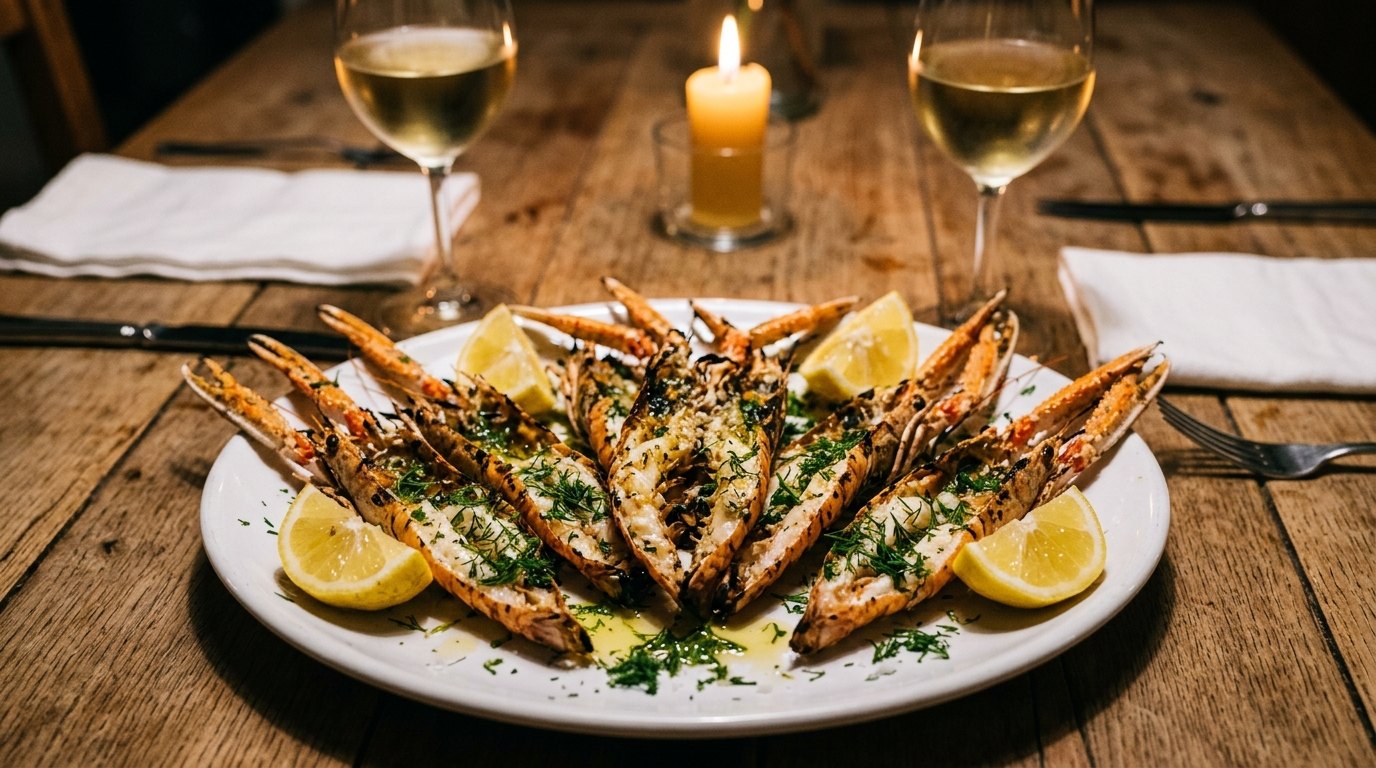
Grilled ginger langoustines plated for an intimate dinner for two. AI-generated illustrations.
See in Photo Comic artLangoustines make you lean in towards each other: you shell them, you get your fingers messy, you hold out a morsel of pearly flesh to your partner, you laugh a little. For a dinner for two, that's exactly what you want, a dish that gives you gestures and not just a taste.
Ginger has always had a reputation as a root that warms you up, and it has to be said that it's well deserved: fresh and grated, it gently tingles on the tongue and leaves a glow at the back of the throat. Add the briny tang of the langoustines, the zing of lemon and a hint of garlic, and you have a match that wakes you up without weighing you down. That's the whole point of this recipe for an evening for two: you leave the table feeling light, not drowsy.
Serve these langoustines as a starter, on warm plates, with country bread to mop up the reduced juices. The marinade is made two hours ahead, and the cooking takes about as long as opening a bottle of well-chilled white wine. You stay seated, fully present, and that may well be the best aphrodisiac on the list.
A dish that gives you gestures and not just a taste.
Method.
9 steps · 28 minutesSqueeze the lemons. Peel the garlic clove, remove the green germ and slice it very finely. Peel the piece of ginger and grate it (or chop it with a knife until it's almost a purée).
Lay the langoustine tails in a shallow dish, in a single layer if possible. Pour over the lemon juice, then add the garlic, ginger and pepper. No salt at this stage: it would draw the water out of the flesh. Cover and leave to marinate in the fridge for 2 hours, turning the langoustines once halfway through.
Drain the langoustines in a colander, then pat them dry gently with kitchen paper: damp flesh boils instead of searing. Strain the marinade through a chinois or a small fine sieve, keep the liquid to one side and throw away the bits of garlic.
Put two plates to warm (in the oven at 60 degrees, or under very hot running water, then dried). Heat a large frying pan over a high heat with the 2 tablespoons of sunflower oil: it should be smoking before the langoustines go anywhere near it.
Add the tails without crowding the pan and sear them for 1 minute 30 to 2 minutes on each side. The flesh turns white and pearly and shrinks slightly (the shell barely changes colour). That's them done: an overcooked langoustine goes woolly.
Transfer the langoustines to the warm plates. Peel them halfway (open the underside of the shell and ease out the flesh, keeping the last segment and the tail fan, which looks prettier and makes them easier to pick up). Now add salt, a pinch at a time.
Put the pan back on the heat, pour in the strained marinade and let it bubble for 2 to 3 minutes, scraping the bottom with a wooden spoon. It should reduce by half and turn syrupy, with that smell of hot lemon and ginger rising all at once.
Spoon the reduced juices over the langoustines, sprinkle with chopped dill and finish with one last grind of pepper. Serve immediately, with the bread so nothing is left on the plate, and napkins, which are essential.
Tips.
The Points G editors
Recipes proofread before publication. The virtues credited to foods owe more to tradition than to science: the pleasure of cooking for two is real enough. AI-generated illustrations.
The whole menu
Halloween dinner for two.
A pumpkin and ginger soup, wild boar roasted with Cahors wine, blood-red candy apples and a glass, not the bottle: a 31 October menu for lovers, with its candlelit table and its games.
Read the menu
01of 09