Aphrodisiac foods.
What tradition credits them with (and what really works)
Oysters, chocolate, honey, spices... For thousands of years, humanity has been hunting for the dish that will set the sheets on fire. Here's what belongs to myth, what belongs to the senses, and how to use it all for an evening that really works.
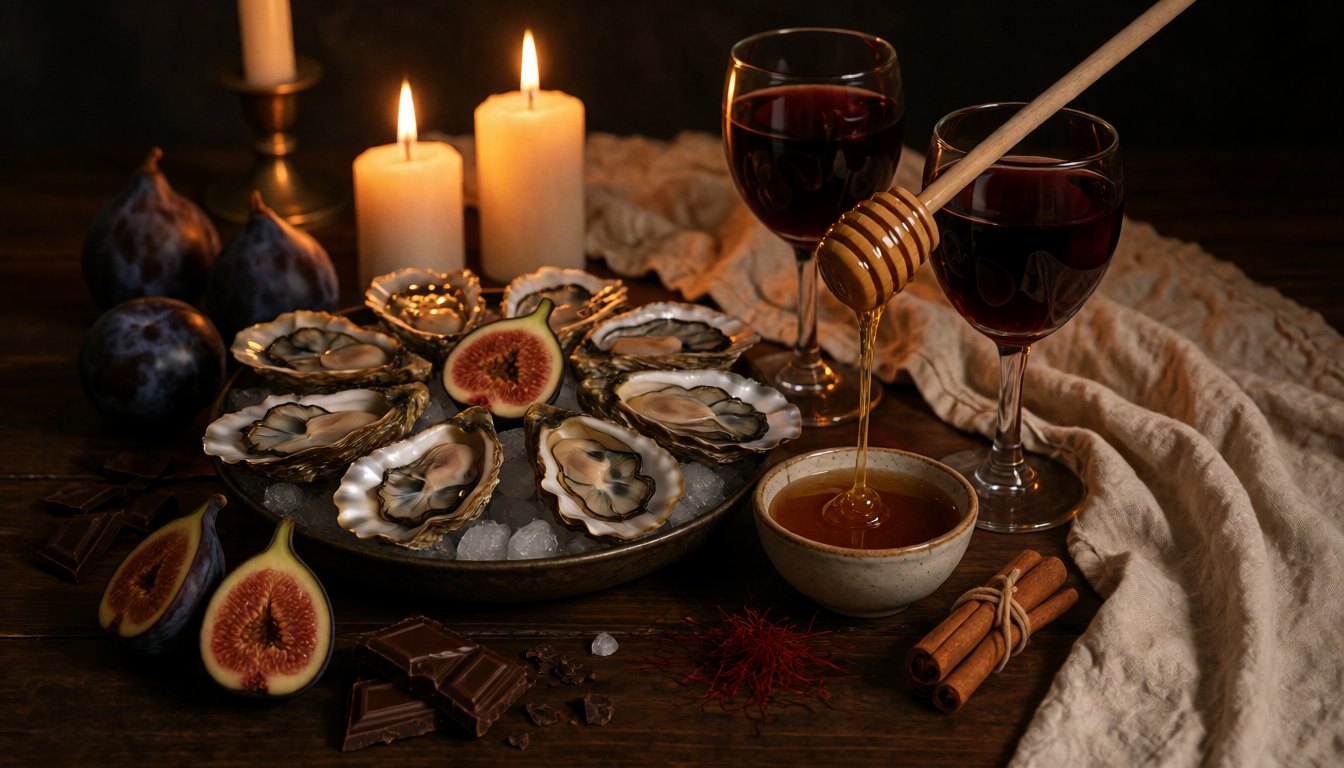
Oysters, figs, dark chocolate, honey, saffron, cinnamon and two glasses of red wine on a wooden table, by candlelight. AI-generated illustrations.
See in Photo Comic artIn short.
5 questions, 5 answers. The detail is in the part shown.
Are there real aphrodisiac foods?
Not in the sense of a trigger: no dish has ever created a craving that wasn't already there. Some foods do act on the body, though (warmth, circulation, energy, a light buzz), others on the imagination, and almost all of them on the mood.
Part 01 · What exactly is an aphrodisiac?What are oysters really worth for libido?
They're among the foods richest in zinc, a mineral essential for producing testosterone. But if you're not lacking it, a dozen won't make your hormones climb: their real strength is the shared ritual of opening and eating them together.
Part 05 · OystersDoes chocolate stimulate desire?
No direct effect has been shown: its phenylethylamine, sold as "the love molecule," comes in tiny amounts and is almost entirely broken down before it reaches the brain. Its mix of sugar and fat does, however, activate the pleasure circuit.
Part 06 · ChocolateDoes alcohol help or hinder desire?
Both, depending on the dose. One glass relaxes you and drops a few inhibitions, but beyond that alcohol dulls sensations, delays orgasm, makes erections harder and clouds judgment.
Part 09 · Wine and champagneWhich so-called aphrodisiacs are dangerous?
Cantharides, which is a poison, yohimbine, which can cause palpitations and a rise in blood pressure, and "natural" supplements sold online that hide erectile dysfunction drugs. Nothing whose ingredients you don't know.
Part 11 · Dangerous false friends you should never swallow
What exactly is an aphrodisiac?
The word comes from Aphrodite, the Greek goddess of love, and it refers to anything supposed to awaken or rekindle desire: a food, a drink, a plant, a scent. The promise is as old as cooking itself, and it still sells.
Let's start with the honest answer: no food triggers desire on command. No dish has ever created a craving that wasn't already there, and nothing serious has shown that oysters or chocolate can do it.
Should we throw it all out, then? No, and this is where things get interesting. Some foods really do act on the body (warmth, circulation, energy, a light buzz), others on the imagination, and almost all of them on the mood of an evening. And desire feeds on all three.
So the plan is simple: understand where these reputations come from and what the body actually does with them, put the great classics to the test, then turn it all into an evening for two.
Why do these foods have such a reputation?
When you look at the list of foods said to be aphrodisiac, four lines of logic keep coming back, and none of them has much to do with chemistry.
- Shape: for centuries, medicine believed nature signaled a plant's use through its appearance (this is the doctrine of signatures). The walnut looks like a brain, so it had to heal the head. The same reasoning made a star of anything that evokes genitals, starting with the avocado, whose Aztec name, ahuacatl, was also used, so they say, to mean testicles.
- Rarity: what's expensive and comes from far away must be powerful. Spices, sugar and chocolate were long luxury goods reserved for wealthy tables, and their prestige did the rest.
- Heat: the old medicine of humors sorted foods into hot and cold. Hot ones (pepper, ginger, cinnamon, wine) were thought to warm the blood and the senses, cold ones (lettuce, cucumber) to cool the ardor.
- Fertility: eggs, seeds, the pomegranate with its thousand pips, anything that carries life has been linked to love and fertility.
These four lines of logic have one thing in common: they speak to the imagination. And as you'll see, in this business the imagination is anything but a detail.
What food really changes about desire
If no food switches on desire on command, what you eat still counts, over time and in a less spectacular way. Desire and arousal rest on three things your plate influences: blood flow, energy and mood.
Blood flow first. An erection, like the swelling of the clitoris and labia, is a matter of blood vessels. Anything that damages the arteries (smoking, too much salt, sugar and fat, lack of exercise) eventually weighs on sexual response, in men and women alike. On the other hand, a Mediterranean-style diet, rich in vegetables, fruit, fish and olive oil, protects the blood vessels. What's good for the heart is good for sex: it's less glamorous than an oyster, but it's solidly established.
Energy next. A meal that's too heavy sends the body off to digest and pushes you toward a nap more than toward caresses. Fatigue remains one of the biggest passion killers, and no dish makes up for it.
Mood last. A good shared meal relaxes, reassures, brings you closer. It's not miracle chemistry, it's pleasure, and pleasure calls for more pleasure.
What's good for the heart is good for sex: it's less glamorous than an oyster, but it's solidly established.
Part 3 · What food really changes about desire
The first aphrodisiac is in your head
Here's the good news: even when a food has no chemical effect at all, it can have a very real one. It's the placebo effect, and it's no illusion. When you expect to feel something, the brain prepares the ground: attention turns to sensations, the body wakes up, and every shiver gets read the right way.
Desire is particularly sensitive to this, because so much of it happens in the head. A dish presented as an aphrodisiac, served with a knowing smile, becomes an invitation. It sets a shared intention: tonight, we're devoting ourselves to each other.
So feed the imagination as much as the stomach. Tell the story of a food's reputation as you serve it, offer a taste from the spoon, leave a little mystery hanging over what comes next. After the meal, settle by the fire or under a throw and read each other a few pages of a sensual novel in a low voice: words often warm better than spices.
The best part is that the game works even when you both know it's a game.

OystersA briny reputation, a real mineral
The oyster is the undisputed star of the aisle. Its shape, its taste of the sea, the way you swallow it in one go, the little ritual of opening it: everything about it tells a sensual story. Its prestige goes way back, since the Romans were so crazy about them that they farmed them in beds as early as the 1st century BC.
On the physiological side, there's a real fact, often misunderstood. Oysters are among the foods richest in zinc, a mineral essential for producing testosterone and sperm. A zinc deficiency can therefore weigh on libido. But if you're not lacking it (which is the case for most people who eat a varied diet), a dozen oysters won't nudge your hormones up a single notch.
What does work is the moment. Opening the oysters together (with a glove and a proper oyster knife, or the evening ends in the ER), serving them on crushed ice with lemon or shallot vinegar, eating them with your fingertips, holding them out to each other... Few dishes create intimacy so fast.
ChocolateLots of pleasure, very little chemistry
Chocolate has carried a reputation as a stimulant ever since it arrived in Europe in the 16th century, back when it was drunk hot and spiced and was thought to warm the senses. Modern legend took over with a molecule with a complicated name, phenylethylamine, sold as "the love molecule" hidden in every bar.
The reality is more modest. Chocolate does contain caffeine and theobromine, two mild stimulants, and a little of that famous phenylethylamine, but in tiny amounts, and the body breaks it down almost entirely before it reaches the brain. No direct effect on desire has been shown.
Its real power lies elsewhere: the mix of sugar and fat activates the pleasure and reward circuit. Chocolate comforts, relaxes, makes you smile. And it's something you give, with all the attention that gesture implies.
To enjoy it together, pick a dark chocolate with at least 70% cocoa (more flavor, less sugar) and serve it in small amounts: a square melting on the tongue, strawberries dipped in melted chocolate, a mousse shared with a teaspoon. The gesture matters as much as the recipe.
Honey, ginger, saffronSweetness and heat
Honey owes its reputation to its sweetness and its age: for thousands of years it was the main sugar in kitchens, and sweetness has always lent itself to romantic metaphors. Physiologically, it mostly provides quickly absorbed sugars, so a small energy boost. Nothing shows, however, that it stimulates sex hormones, despite what you often read.
Ginger, cinnamon, cardamom and cloves belong to the family of so-called warming spices. They give a sensation of heat in the mouth and the body, and they perfume the breath (a detail that's no small thing when you're kissing). None of them has been shown to change desire, but all of them wake up the taste buds and make a dish memorable.
Saffron is in a class of its own. It's the most expensive spice in the world, which is enough to give it an air of luxury, and it's one of the few spices studied for its effects on sexuality, with results still far too thin to make a promise out of. A few threads in a risotto or a custard, and the golden color already works its magic.
With spices, the golden rule is a light hand: a pinch perfumes, a spoonful overwhelms. A ginger and honey tea after dinner, a pear poached with cinnamon, a cardamom rice pudding... it's simple, warm, and made for sharing.
Chili and pepperWhen the body thinks it's aroused
Chili deserves a special mention, because it does a wonderful impression of the signs of arousal. Capsaicin, the molecule that makes it burn, speeds up the heart, brings a flush to the cheeks, triggers a light sweat and pushes the body to release endorphins, those substances that create a feeling of well-being.
So the body ends up in a state very close to desire: warm, alert, a little breathless. It isn't desire, but the brain is easily fooled, especially if the person sitting across from you gives it a good reason to be.
Pepper plays in the same league, more gently. It livens up dishes and makes you thirsty (for water, or for something more interesting).
The instructions fit in one sentence: a spicy dish rather than a scorching one. If one of you can't handle chili, dinner turns into a survival test and the evening ends right there. And after cutting a fresh chili, wash your hands thoroughly before rubbing your eyes... or touching anything else.
Wine and champagneThe first glass and the one too many
Alcohol is probably the most widely consumed aphrodisiac in the world, and the most deceptive. One glass relaxes you, loosens your tongue, drops a few inhibitions: on that point, the reputation is deserved.
Beyond that, the curve turns around fast. Alcohol slows down the nervous system: it dulls sensations, delays or prevents orgasm, makes erections harder and can dry out the mucous membranes. The desire is there, the body just doesn't follow. It also clouds judgment, and a yes given after several drinks isn't worth a yes given with a clear head: consent is checked, never assumed.
Champagne holds a special place in the imagination, with bubbles that go straight to your head (the gas speeds up the passage of alcohol into the blood). It brings the party, as long as you stick to a glass or two.
In practice: one or two well-chosen glasses, a glass of water alongside, and the rest of the bottle for another night. If things keep misfiring in bed despite moderate drinking, it's no longer about the wine: talk to a doctor.
Fig, pomegranate, peachThe fruits of desire
The fig owes everything to its shape and its flesh: cut in half, it needs no commentary, and the ancient poets made the most of it. The pomegranate, with its hundreds of red seeds, has been a symbol of fertility just about everywhere. In Greek myth, it was for eating a few of its seeds that Persephone had to return every year to her husband, the god of the Underworld: the pomegranate binds those who share it.
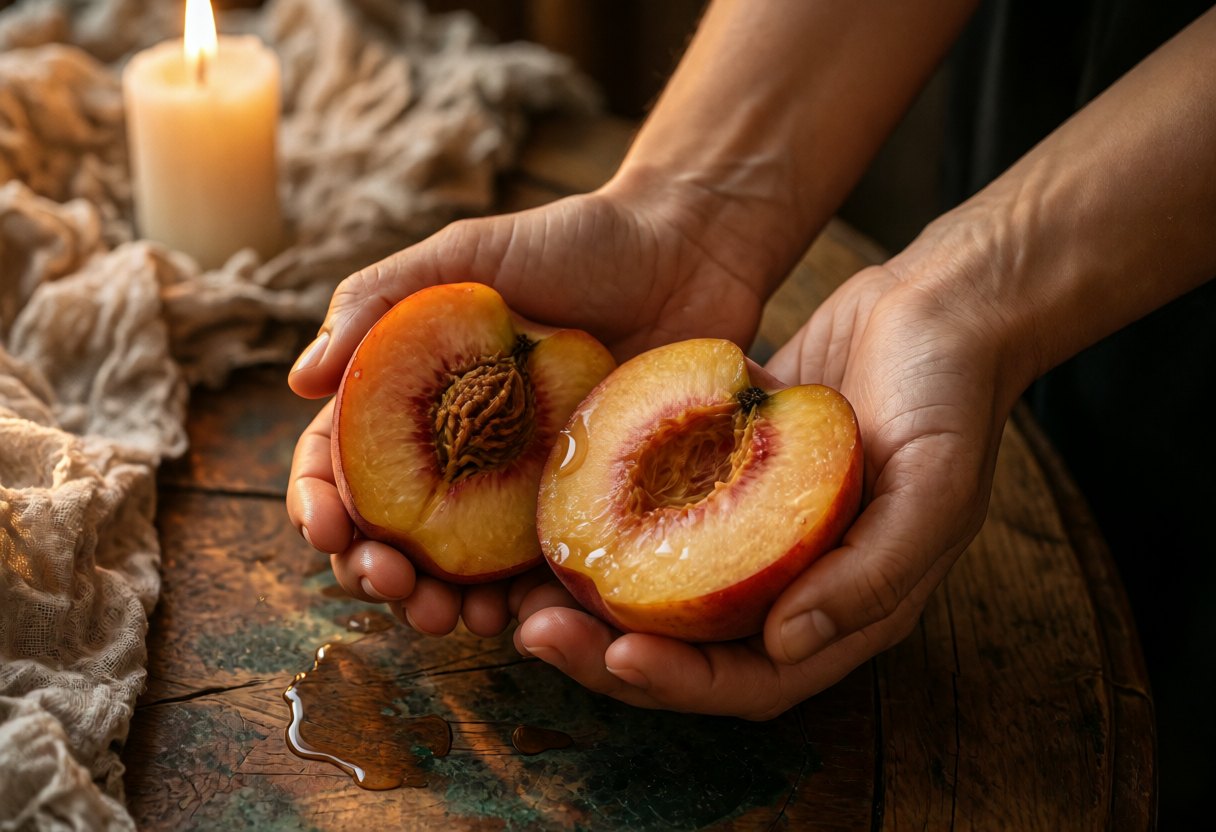
The peach, for its part, plays on skin. Its fuzz, its flesh that gives way under your teeth, its juice running down your fingers: hard to get more sensual than that. In China, peach blossom is even associated with love, so much so that people speak of "peach blossom luck" for a stretch of happy encounters.
None of these fruits acts on desire, strictly speaking. What makes them precious: they're beautiful, fragrant, a little messy, and made for sharing. A peach cut in two, figs split open, pomegranate seeds pecked from your partner's palm... the gesture does all the work.
To serve them: figs roasted in the oven with a drizzle of honey, a peach and raspberry salad with mint, pomegranate seeds over Greek yogurt. Pick them very ripe and take them out of the fridge ahead of time: a fruit that's too cold loses its fragrance.
Dangerous false friends you should never swallow
In its hunt for the miracle cure, humanity has swallowed some truly dangerous things, and some of them are still going around.
- Cantharides, also known as Spanish fly, is actually a small beetle. Ground into powder, it violently irritates the urinary tract, which may once have passed for arousal. It's a poison: the dose that works is close to the dose that kills.
- Yohimbine, taken from the bark of a Central African tree, has been prescribed for erectile problems with modest results. It can cause anxiety, palpitations and a rise in blood pressure, and it has no business in a homemade cocktail.
- Rhino horn is nothing but keratin, the stuff our nails are made of. It does nothing at all, but its reputation still fuels poaching.
- "Natural" supplements sold online: health authorities regularly flag capsules sold as 100% plant-based that actually contain, without saying so, erectile dysfunction drugs. Combined with certain heart medications, the mix can be dangerous.
The rule is simple: nothing sold under the counter, nothing whose ingredients you don't know. And if your desire has been flagging for a while, if erections are a problem or if sex is painful, the right move isn't a miracle bottle but an appointment with a doctor or a sex therapist. These issues can be treated, and sometimes they point to something else that's better not left to linger.
The real mood killers at the table
Before looking for what turns you on, it's worth knowing what turns you off. At the table, the most effective anti-aphrodisiacs are also the most ordinary.
- The overly heavy meal: three dishes in sauce and a cream dessert, and the evening ends on the sofa, each on your own side, digesting.
- Foods that bloat: cabbage, beans and lentils, sodas in large amounts. No need to draw you a picture.
- Raw garlic and onion, when only one of you has eaten them. Shared, they bother no one.
- Too much alcohol, as we saw above.
- Too late an hour: a dinner that starts at 10 pm after a long day has little chance of ending in fireworks.
- Screens: one phone on the table, and attention drifts elsewhere.
- Pressure: an "aphrodisiac" dinner that turns into an obligation to deliver turns no one on. If one of you isn't in the mood that night, the meal is still a good meal, and that's perfectly fine.
In short, the best aphrodisiac often starts with removing what gets in the way.
Putting together a plate that makes you want more
For a dinner for two, the ideal plate comes down to four words: light, fragrant, shared, colorful.
- Light: small portions, little cream, little fried food. You should leave the table wanting to move, not to sleep.
- Fragrant: fresh herbs, citrus zest, gentle spices. Smell is closely tied to memory and emotion, and a dish that smells good makes your mouth water before the first bite.
- Shared: one big dish in the middle of the table, bites to pick at, foods you eat with your fingers. Holding out a bite to someone is already touching them.
- Colorful: the red of strawberries and pomegranate, the gold of saffron, the deep brown of chocolate. We eat with our eyes first.
A few easy pairings that tick every box: oysters with shallot vinegar, shrimp sautéed with ginger and lime, beef carpaccio with arugula and parmesan shavings, strawberries and mango slices with a little bowl of melted dark chocolate.
And if you don't cook, it doesn't matter one bit: a good deli, pretty plates and two candles will do the job nicely. What counts is the care you put into it, not the time spent at the stove.
An aphrodisiac evening for two, step by step
During the day: a message to announce the plan ("tonight, aphrodisiac dinner, I'm taking care of everything"), without giving it all away. Anticipation is part of the pleasure, and a day spent thinking about it beats any aperitif.
The preparation: if you cook together, stick to simple tasks (washing, chopping, tasting) so cooking stays a game and not a chore. A playlist, soft lighting, phones in a drawer.
The meal: small plates, time between each one, comments on the aromas and textures. Feed each other tastes, let the silences linger. Between two courses, nothing stops you from leaving the table for a few minutes to dance or kiss in the kitchen.
Afterwards: dessert can just as well be had somewhere other than the table, on the sofa or in bed, with a bowl of fruit and a few squares of chocolate. The dishes can wait until tomorrow.
Part 15 · for membersThe blind tasting game
To end the evening on a high note, here's a game that brings together everything we've just covered: the blind tasting. It takes ten minutes of preparation and a scarf.
The rest is for members
The rest of the article opens with a free account, and you come back right here.
Texts written from the books of sexologists and therapists, proofread before publication. AI-generated illustrations, no real person. Our advice does not replace medical advice.



And the two of you, under which stars?
Two dates of birth are enough to read your love compatibility.