It pulls, it stings, sex becomes uncomfortable and desire drifts away... Vaginal dryness affects a huge number of women around menopause, and we still talk about it far too little. Here's what's happening in your body, and above all everything you can actually do about it.

A woman in her fifties sitting on the edge of her bed, relaxed, with oils in amber bottles and flaxseeds on the bedside table. AI-generated illustrations.
See in Photo Comic artIn short.
5 questions, 5 answers. The detail is in the part shown.
Why does menopause dry out the vagina?
Estrogen, which plays a direct role in keeping mucous membranes hydrated, starts declining in your forties and then more and more. Secretions become less abundant, and your skin, mouth or eyes can dry out too.
Part 02 · Why falling estrogen dries everything outHow do you moisturize the vulva day to day?
A few drops of a virgin, organic, unscented plant oil (sweet almond, evening primrose, coconut) on the vulva, after the shower or after making love. For the inside of the vagina, a vaginal moisturizer from the pharmacy is better suited.
Part 08 · Soothing oils, the after-shower reflexWhich lube should you choose for sex?
With condoms, you need a product with no fats, since oil damages latex: water-based lube, pure aloe vera gel or homemade flaxseed gel. Without a condom, a plant oil glides longer and nourishes the vulva.
Part 09 · The right lube during sex (and a homemade recipe)What is longer foreplay for?
It gives lubrication time to arrive, since it now takes longer. During caresses, the vulva and clitoris fill with blood and the vaginal wall grows moist: rushing this stage means asking a fragile mucous membrane to work cold.
Part 13 · Make foreplay last longerWhat can your doctor offer when oils aren't enough?
Vaginal moisturizers (gels or suppositories, often with hyaluronic acid) and low-dose estrogen applied locally, which remains the gold-standard treatment. The choice depends on your history, your medical background and your symptoms.
Part 14 · What you can ask your doctor
Genitourinary syndrome of menopause, so often overlooked
It's called GSM, and behind that rather clinical acronym lies a very concrete reality. The tissues of the vagina, vulva, urethra and bladder depend closely on estrogen: they need it to stay thick, supple and well supplied with blood. When the hormone withdraws, they feel it directly.
The picture varies from one woman to another: dryness and tightness, burning or itching of the vulva, pain during sex, needing to pee more often, small leaks, cystitis or vaginitis that keeps coming back, sometimes thinner pubic hair. These signs often pile up, and they can be treated.
The real problem is the silence. Many women put up with it for years, telling themselves it's just age, that's how it is. Yet simple solutions exist, and the first step is always the same: daring to put words to it, with your doctor as well as with your partner.
Why falling estrogen dries everything out
The hormonal decline doesn't start on the day of menopause. It begins in your forties and gradually intensifies, which explains why some women notice less abundant secretions well before their periods stop.
Estrogen plays a direct role in keeping mucous membranes hydrated. When levels drop, the vagina isn't the only one to suffer: the other mucous membranes and the skin do too. It's actually a good indicator: if you've noticed that your eyes, mouth, skin and hair are drier than before, the hormonal decline is probably to blame (marked dryness of the eyes and mouth still deserves a medical opinion).
Response time gets longer too: where a few dozen seconds of caresses were enough at thirty for lubrication to arrive, it often takes one or several minutes after menopause. It's not a breakdown, it's a delay, and it changes a lot about how sex unfolds.
Vaginal atrophyA thinner, more fragile lining
The term sounds scary, yet it describes something fairly mechanical. The vaginal lining gradually thins, it narrows a little, and both the outer and inner labia become finer. A thinner wall is a wall that gets irritated more quickly, from the rubbing of tight clothes as well as during sex.
And some very good news, rarely mentioned: the clitoris stays largely sensitive over the years. Its thousands of nerve endings are still there, and since its internal parts surround the entrance to the vagina, it also contributes to the pleasure felt inside. The potential for sensation hasn't evaporated.
And some very good news, rarely mentioned: the clitoris stays largely sensitive over the years.
Part 3 · Vaginal atrophy
A disrupted microbiomeWhy infections keep coming back
The vagina is home to a protective flora dominated by lactobacilli. These good bacteria produce lactic acid, which keeps the pH naturally acidic, and that acidity is your best barrier against harmful bacteria.
At menopause, the vaginal microbiome changes, notably with a loss of lactobacilli. Less lactic acid, a rising pH, and the door swings open: vaginitis, recurring cystitis, itching. We often experience it as bad luck when really it's a changed terrain.
Against cystitis, the first reflex is to pee after every time you have sex, to flush out bacteria that may have traveled up toward the urethra. Cranberry and certain vaginal probiotics are often suggested as prevention, with results that vary from one woman to another. An actual infection, however, needs to be diagnosed and treated by a professional, and repeated infections after menopause are precisely a good reason to discuss local treatment with your doctor.
What it really feels like day to day
Vaginal dryness isn't limited to intimate moments, far from it. It's a constant background discomfort: a tight, pulling sensation, a vulva that itches in the evening, synthetic underwear that becomes unbearable, jeans that rub.
On top of that there's often a frequent urge to pee, sometimes small leaks when exerting yourself or sneezing, and that unpleasant feeling of no longer being quite at home in your own body.
These are benign symptoms in the medical sense. Benign doesn't mean negligible: when it itches every day and sex becomes painful, it weighs on your mood and on your relationship. You have every right to want it to stop.
Low libidoHormones aren't everything
Yes, the drop in estrogen can weigh on libido. But the other hormone of desire, testosterone (women make it too, in small amounts), doesn't plummet at natural menopause: its decline is slow and spread over the whole of adult life. So desire has no built-in off switch.
Above all, female desire depends on a host of other factors that have nothing hormonal about them: emotional state and stress, how you see your body, past experiences, availability and mental load, the quality of the relationship, communication as a couple. So many levers you can act on, and that's rather encouraging.
A first sorting-out helps a lot: is pain cutting off a desire that's there, or has the desire disappeared on its own? In the first case, treating the dryness is often enough to get desire back. In the second, it's better to look at fatigue, stress or the relationship, and a sex therapist can help untangle all of that.
Another asset of this period, often underestimated: experience. You know your body better, you know what you like and what you won't do, and you dare to say so more. That's a solid base to start again from.

Related signs to watch, without panicking
Intimate dryness rarely comes alone. It's part of a wider hormonal imbalance that can bring hot flashes, sleep problems, irritability or joint pain.
Good news: many of these symptoms, like hot flashes, eventually ease over the years. Intimate dryness, on the other hand, tends to settle in if you do nothing: all the more reason to deal with it right away.
Two subjects also deserve monitoring: the pelvic floor, which can weaken to the point of causing leaks or organ descent (a prolapse), and the breasts, whose mammogram screening continues at this age.
If in doubt, in pain, with an infection that drags on or unusual bleeding, don't tinker on your own: see a doctor. That goes for everything that follows in this article.
Soothing oils, the after-shower reflex
We moisturize our face every day without thinking, and completely forget about this area. Yet it's one of the simplest things you can do against irritation: a gentle plant oil applied to the vulva, after the shower or after making love.
No need for a complicated formula: a single virgin, organic, unscented oil does the job, such as sweet almond, evening primrose or coconut. A few drops are enough, warmed between your fingers and applied to the outer and inner labia.
As a daily treatment, the oil goes on the outside, on the vulva: to moisturize the inside of the vagina, a vaginal moisturizer from the pharmacy is better suited. Another limit of oil: it damages latex condoms. And never any essential oil on this area, far too irritating.
One last precaution: a test on a small patch of skin (the crook of your elbow, for example) before the first application, to check there's no reaction. If irritation persists despite this care, talk to your doctor: a local treatment can take over.
The right lube during sex (and a homemade recipe)
Lube isn't an admission of failure, it's a comfort tool, period. It's a game changer when the lining is thin and natural lubrication takes its time.
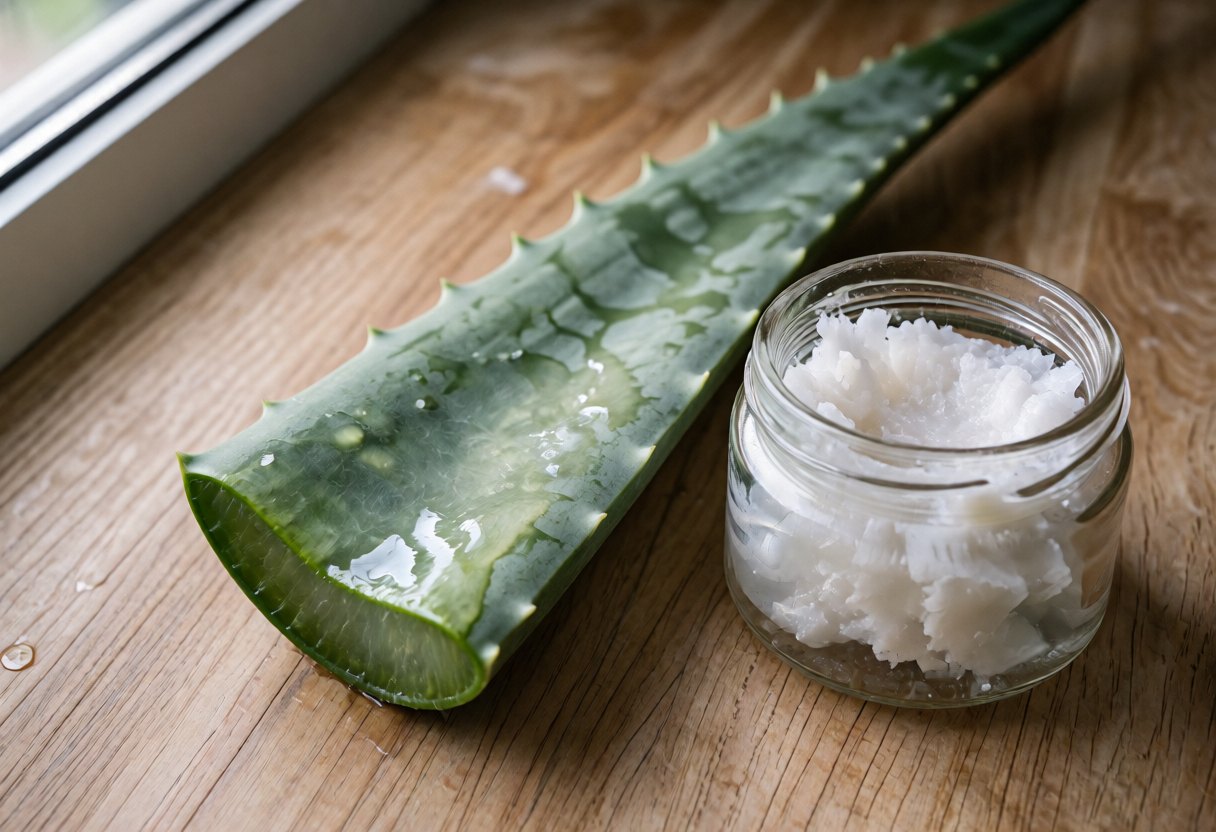
If you use condoms, you need a product with no fats, because oil damages latex: a store-bought water-based lube, or pure aloe vera gel, with no alcohol or fragrance. For a homemade version, flaxseed gel: simmer a tablespoon of seeds (about 10 g) in 20 cl of water for around ten minutes, stirring, then strain while hot, before the gel sets as it cools. With no preservatives, it keeps for a few days in the fridge, in a very clean glass jar, and you throw it out at the slightest smell. These gels dry faster than a store-bought lube: you sometimes need to add more along the way.
Without a condom, a plant oil (sweet almond, virgin coconut) glides longer and nourishes the vulva at the same time. It does stain the sheets, though, and if you get repeated vaginal infections, it's best to ask for advice before using it inside.
If homemade doesn't appeal, there are ready-to-use natural lubes formulated for this area. The key is to choose a short ingredient list that respects your intimate pH.
Intimate hygieneThe less you do, the better
The most common mistake is overdoing it. Too much soap, too harsh, too deep: you destroy what little protective flora remains and feed the vicious circle of irritation and infection.
The rule: you only wash the outside, the vulva, never the inside of the vagina, which cleans itself. Water or a gentle, unscented wash suited to intimate pH, applied by hand rather than with a washcloth, once a day, is plenty. Then pat dry.
A few habits matter too: drinking regularly throughout the day, choosing cotton over synthetic materials for underwear and pads, and avoiding overly tight pants day to day.
Supplements and plantsWhat can help (with caution)
Taken orally, several supplements are offered for dryness: evening primrose or borage oil in capsules, omega-3s (or two servings of small oily fish a week) and probiotics aimed at the vaginal flora. Their benefit is plausible, but their effect on vaginal dryness remains poorly proven: think of them as a little extra help, not a treatment.
As for plants, the most often cited contain phytoestrogens, molecules that weakly mimic estrogen: red clover, hops, sage, and also soy and flaxseed on your plate. Maca and ashwagandha, often sold for libido, belong to another family (the so-called adaptogenic plants), as does ginseng, known as a tonic and best taken in the morning. Cranberry, for its part, is mainly about preventing urinary infections.
Careful, this is not trivial. Phytoestrogen plants are not recommended if you have a personal or family history of breast cancer. Some plants interact with medication, like ginseng with anticoagulants or diabetes drugs. And avoid stacking several products at once: the effects add up, and so do the risks.
The right reflex is still to ask your doctor or gynecologist which ones suit your situation. A course of supplements is chosen, not thrown together at random from the shelves.
Think about the whole genitourinary area, not just the vagina
Vulva, vagina, bladder, pelvic floor: this whole little world works together. Strengthening the pelvic floor improves bladder comfort, and a calm gut protects everything.
Day to day, the best way to protect your pelvic floor is to avoid pushing: fight constipation (fiber, water, physical activity), don't strain on the toilet, and contract your pelvic floor just before exerting yourself, coughing or sneezing, so it doesn't take the pressure head-on. A small footstool under your feet on the toilet also helps you sit in a more natural position.
If leaks or a feeling of heaviness appear, pelvic floor rehabilitation with a midwife or a physical therapist gives good results, and it can be prescribed. To keep things up afterward, a few pelvic floor strengthening exercises, or an activity like Pilates, fit easily into the week.
More broadly, fatigue and stress amplify all the symptoms of this period, intimate ones included. Sleeping, moving and easing off whenever you can is part of the solution.
Make foreplay last longerThe most effective key
Lubrication now takes longer to arrive. If sex starts at the same tempo as twenty years ago, the body simply can't keep up. Hence the discomfort, then the apprehension, then the avoidance.
During foreplay, the body gets ready: relaxation lets the blood vessels open, the vulva and clitoris fill with blood, the vaginal wall grows moist and supple. Rushing this stage means asking a fragile mucous membrane to work cold.
Desire, too, often takes its time: for many women, it comes during caresses rather than before. In practice: slowness, caresses away from the genitals to begin with, words, a warm atmosphere, and no phone within reach.
And masturbation keeps its full place: it lets you discover what works with this body, and it keeps blood flowing to the area.
What you can ask your doctor
There are medical solutions when oils and lube aren't enough, and nothing obliges you to go without them. Among those you can bring up during a consultation: vaginal moisturizers (gels or suppositories, often with hyaluronic acid), low-dose estrogen applied locally, which remains the gold-standard treatment, and more recent techniques like vaginal laser or hyaluronic acid injections, whose effectiveness is still debated. The choice depends entirely on your history, your medical background and your symptoms, so it's a discussion, not an à la carte menu.
You can also ask for a prescription for pelvic floor rehabilitation, treatment for recurring infections, advice on the supplements suited to your case, and a general check-up with blood tests if you feel exhausted.
Make the most of it to review your screenings: an HPV test every five years until 65, a mammogram every two years from 50 to 74, or earlier if your doctor thinks it useful.
Finally, know who does what: the doctor or gynecologist for the body and treatments, the sex therapist for desire, the relationship and what's going on in your head. Seeing both is not contradictory at all, quite the opposite.
Part 15 · for membersTalking to your partner, without drama and without silence
The worst scenario is the unspoken. You avoid sex because it hurts, your partner concludes they no longer turn you on, and the misunderstanding settles in for months. A ten-minute conversation is often enough to defuse all of it.
The rest is for members
The rest of the article opens with a free account, and you come back right here.
Texts written from the books of sexologists and therapists, proofread before publication. AI-generated illustrations, no real person. Our advice does not replace medical advice.
To go on.




And the two of you, under which stars?
Two dates of birth are enough to read your love compatibility.